
Employees working in the Dubai International Financial Centre (DIFC) follow a completely different system for end-of-service savings compared to the traditional UAE gratuity model. Since February 2020, DIFC replaced its old End-of-Service Gratuity System (EGS) with the DEWS DIFC Employee Workplace Savings Plan, a modern, funded, and professionally managed savings scheme aligned with global retirement standards.
This updated 2026 guide explains the DIFC savings scheme’s full structure, how contributions work, who manages the funds, employee benefits, exemptions, voluntary savings, and how this savings plan differs from the traditional gratuity system in Dubai. To calculate end-of-service benefits for jobs outside DIFC, you can use the UAE gratuity calculator.
Whether you’re an employer in DIFC or an employee planning your long-term financial security, this guide gives you everything you need to know about the mandatory workplace savings system in DIFC.
Overview of the DEWS – DIFC Employee Workplace Savings Plan
The workplace savings scheme introduced under DIFC Employment Law No. 2 of 2019 replaced the legacy gratuity model with a transparent, funded system aligned with global retirement and investment standards.
Instead of receiving a lump-sum benefit at the end of employment, employees now receive monthly employer contributions into an investment account, with the option to make additional voluntary contributions.
Core Objectives of the Scheme:
- Protect employee funds
- Provide transparency and financial visibility
- Allow investment growth
- A funded model ensuring money is always available
- Offer flexible, globally recognized workplace savings
How the DIFC Savings Scheme Works
Under framework of this plan, all eligible employers must contribute a percentage of each employee’s basic salary into the scheme.
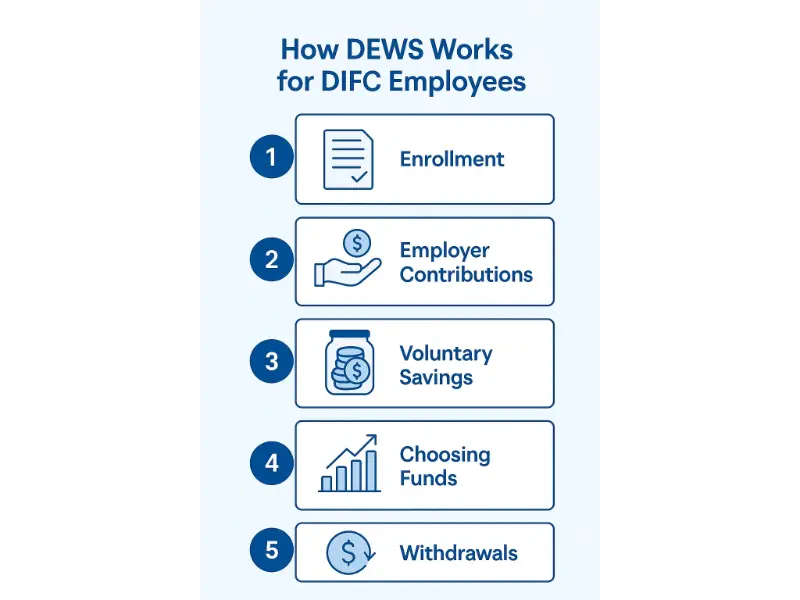
Employer Contribution Rates
- 5.83% of basic monthly salary (less than five years of service)
- 8.33% of basic monthly salary (five or more years of service)
Contributions must be submitted by the 21st of each month. Late submissions may lead to compliance action by the DIFC Authority.
Voluntary Contributions
Employees may choose to add voluntary contributions to increase their long-term savings.
- Partial withdrawals allowed up to two times per year
- Maximum of 30% per withdrawal
Investment & Fund Options
Employee funds are fully funded and professionally managed, held by an independent master trustee, ensuring protection and transparency. Employees can choose from multiple portfolios, including:
- Low/Moderate Growth Fund (default)
- Risk-based model portfolios
- Sharia-compliant investment options
- Responsible/ESG-oriented portfolios
Employees can switch funds anytime based on risk tolerance.
Key Entities Managing the Workplace Savings Plan
DIFC appointed leading industry partners to operate the scheme:
- Equiom – Global trust services provider and master trustee
- Zurich Middle East – Plan administrator
- Mercer – Investment adviser
- Smart Pension – Technology services provider
- Investment Funds – Multiple options, including Sharia-compliant choices
These entities ensure strong governance, transparency, and regulatory compliance.
Benefits of DIFC Savings Scheme for Employees
The system provides employees with greater security and investment opportunities compared to the old gratuity model.
Main Benefits
- Guaranteed employer contributions every month
- A funded structure, ensuring money is always available
- Investment growth over time
- Sharia-compliant and global investment options
- Online portal for tracking performance and contributions
- Portability within DIFC—new employer, new account, no loss of funds
- Ability to keep investments growing even after employment ends
Access to Funds
When leaving employment in DIFC, employees can:
- Withdraw their full balance upon exit
- Keep the funds invested
- Transfer voluntary contributions
- Make partial withdrawals (voluntary savings only)
Benefits for Employers
Employers benefit from predictable and transparent end-of-service liabilities.
Key Advantages:
- Improved cash flow certainty
- Clear EoSB obligations
- Compliance with DIFC Employment Law
- Professional management of employee savings
- Attractive for top global talent No final-salary liability shock at termination
Withdrawal Process – Step-by-Step (Updated 2026)
A complete withdrawal can be initiated once employment ends. Here is the formal process:
- Termination or Resignation
- Employment ends and the employer notifies the scheme administrator.
- Final Payroll Submission
- Employer submits the final monthly contribution.
- Employee Accesses the Member Portal
- Log in through the DEWS Dubai online platform.
- Submit Withdrawal Request
- Choose full withdrawal, partial withdrawal, or transfer.
- Required Documents
- Passport copy
- UAE visa cancellation or proof of exit
- Bank account IBAN
- Emirates ID (if still available)
- Processing Timeline
- Funds are typically transferred within 3–10 working days
- After Leaving DIFC
- Employees may keep the account active for continued investment if preferred.
Employer Obligations Under DIFC Law
Employers inside the financial centre must:
- Register employees upon joining
- Submit contributions by the monthly deadline
- Maintain accurate salary data
- Ensure compliance if switching to a Qualifying Alternative Scheme (QAS)
- Provide accurate off-boarding information
Penalties for Late or Missing Contributions
The DIFC Authority may impose:
- Fines
- Enforcement actions
- Compensation claims by affected employees
Exemptions from the DIFC DEWS
The scheme does not apply to:
- UAE and GCC nationals covered under GPSSA (General Pension and Social Security Authority)
- Employees under a qualifying alternative scheme that offers equal or better benefits
- Employees with special exemptions approved by DIFC
Comparison: DIFC Savings Model vs UAE Gratuity System
Employees inside DIFC follow the funded savings model, whereas free zones outside DIFC use the traditional gratuity system.
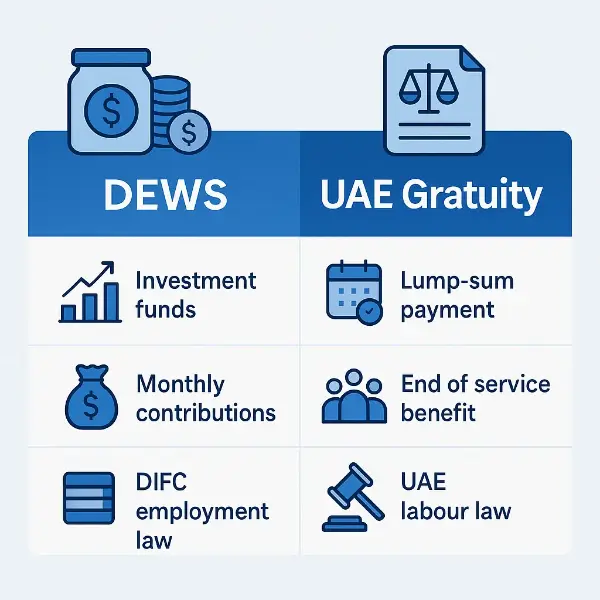
| Aspect | DIFC Savings Plan | UAE Gratuity (Mianland & Freezones) |
|---|---|---|
| Structure | Funded monthly contributions | Lump-sum at end of service |
| Investment | Yes | No |
| Management | Professionally managed | Not invested |
| Visibility | Full transparency & online tracking | No ongoing visibility |
| Flexibility | Voluntary contributions, withdrawals | Fixed calculation model |
| Growth | Investment-based returns | Salary-based, no growth |
Free Zones That Still Follow Traditional Gratuity
Most free zones continue using the UAE Labour Law for calculating end-of-service gratuity, including:
- DMCC
- DAFZA
- Dubai South / DWC
- Dubai Silicon Oasis
- JAFZA (with its own specific rules)
The funded savings model applies only inside DIFC, unless a company is enrolled in a DIFC-approved alternative scheme.
What About Gratuity in Dubai? (Brief Explanation)
For employees outside DIFC, gratuity still applies under the Federal Decree Law No. 33 of 2021.
Key points:
- 21 days of basic salary for each of the first 5 years
- 30 days for each year after 5 years
- Must complete at least one year
- Resignation rules apply
- Gross misconduct can cause forfeiture (Article 44)
As per the rules and formula used by Dubai Trade.
FAQ’s
Final Thoughts
The DIFC workplace savings is a modern, transparent, and professionally managed alternative to the traditional gratuity system, designed to help DIFC employees build long-term savings with greater security and investment growth opportunities. Whether you’re an employer or employee, understanding DEWS ensures compliance with DIFC Employment Law and provides better financial planning for the future.
If you work inside DIFC, make sure you are enrolled in the scheme, verify contributions regularly, and review your investment portfolio to maximize long-term financial growth.