
Overtime Calculation in UAE: Complete Guide for 2026
Overtime calculation in UAE is one of the most searched topics among employees and HR teams across the country. Whether you want to understand UAE overtime pay, verify your salary slip, or simply find a reliable UAE overtime pay calculator, knowing the correct method matters: legally and financially.
This guide covers everything: overtime salary calculation UAE, the legal framework, step-by-step formulas, five real-life examples, and the most common mistakes to avoid. If you have been wondering how to calculate overtime in UAE or what is overtime pay UAE, you are in the right place.
Quick Summary (2026 UAE Overtime Rules)
What is Overtime in UAE?
Overtime in UAE means:
Overtime refers to work beyond normal hours, specifically any extra hours worked outside the standard limits set by UAE labour working hours law and your employment contract.
How to Calculate Overtime in the UAE?
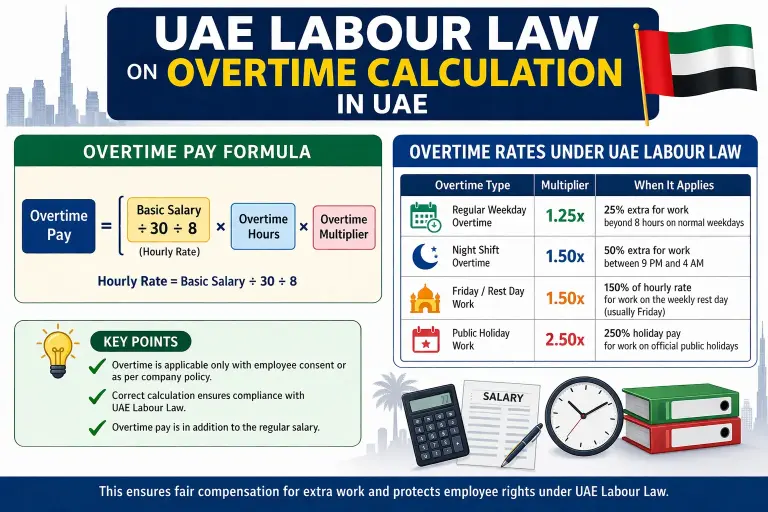
The overtime formula UAE is built on your hourly rate. Here is the standard method used across all compliant payroll system UAE operations:
Overtime Pay Formula UAE:
Overtime Pay = Hourly Rate × Overtime Hours × Overtime Multiplier
Hourly Rate Formula UAE:
Hourly Rate = Basic Salary ÷ 30 ÷ 8
So, putting the hourly rate formula in our overtime pay formula, it becomes;
Overtime Pay = (Basic Salary ÷ 30 ÷ 8) × Overtime Hours × Multiplier
This basic salary calculation UAE approach divides the monthly basic salary by 30 days, then by 8 working hours, giving the value of one standard hour. The overtime pay formula is the foundation of correct wage calculation, salary structure UAE management, and clean salary breakdown UAE reporting.
Overtime Rates and Calculation Formula
To perform any accurate OT calculation in UAE, you need two things: the correct hourly rate and the correct overtime multiplier.
| Overtime Type | Multiplier | Effective Rate | When It Applies |
|---|---|---|---|
| Regular weekday overtime | ×1.25 | 25% extra (125% of hourly rate) | Work beyond standard hours in normal week days |
| Night shift overtime | ×1.50 | 50% extra (150% of hourly rate) | Work between 9 PM and 4 AM. |
| Friday / Rest day work | ×1.50 | 50% extra (150% of hourly rate) | Work on weekly rest day. |
| Public holiday work | ×2.50 | 150 % extra (250% of hourly rate) | Work on official public holidays. |
These are the official UAE Overtime Rates that every employer must apply. Using the wrong multiplier; for example, treating Friday as regular overtime — is a compliance violation under labor regulations UAE.
Standard Working Hours in UAE
Understanding the UAE labor law standard working hours limit is the starting point for any accurate overtime salary calculation UAE.
- 8 hours per day (daily working hours)
- 48 hours per week (weekly working hours) it can be either 8 hours/day for 6 days or 9.5 hours/day for 5 days.
Any time exceeding these thresholds counts as overtime hours and must be compensated under overtime rules UAE.
Break Rules: Breaks (lunch/prayer) are NOT included in working hours. This is an important detail many employees overlook when calculating their actual hours on the clock.
Night Shift: Employees working night shift hours may qualify for night overtime UAE, depending on the specific hours worked and their employment contract terms. In some industries, such as hospitality and aviation, overtime hours are referred to as duty time, the same UAE labor law rates and rules apply regardless of the terminology used.”
Types of Overtime
Overtime in the UAE can be understood from two angles: why it happens (the legal basis) and how it is paid (the rate classification). Both matter, one for employer compliance, the other for payroll accuracy.
By Legal Basis (Why Overtime Occurs)
UAE labor law recognizes two grounds under which overtime may be required:
Force Majeure Overtime
This applies when urgent and extraordinary circumstances arise that require immediate action to prevent or repair serious damage. Examples include equipment failures, safety emergencies, or situations where stopping work would cause significant harm. This is the narrow emergency exception under UAE labor law and cannot be routinely scheduled.
Structural Overtime
This applies when workload peaks or unexpected operational demands require employees to work beyond normal hours. This is the more common, day-to-day form of overtime in UAE businesses and must still comply with the 2-hour daily maximum and applicable pay rates.
By Payment Rate (How Overtime Is Paid)
Once the legal basis for overtime is established, the correct pay rate is determined by when and on which day the overtime hours fall:
Regular Overtime
Work beyond 8 hours on a regular weekday, paid at 25% above the normal hourly rate (×1.25 multiplier).
Night Overtime UAE
Work performed during designated night hours, paid at 50% above the normal rate (×1.50 multiplier).
Friday Overtime UAE
Work done on the weekly rest day UAE, paid at 150% of the hourly rate (×1.50 multiplier). Alternatively, the employer may grant a substitute rest day in lieu of payment.
Public Holiday Overtime UAE
Working on a UAE public holiday, paid at 250% holiday pay (×2.50 multiplier); the highest rate under UAE law.
Note: A single overtime instance can span both categories. For example, an emergency repair on a Friday night is both Force Majeure and Friday-rate overtime. The legal basis determines whether it can be required; the rate classification determines how much is owed.
UAE Labor Law on Overtime
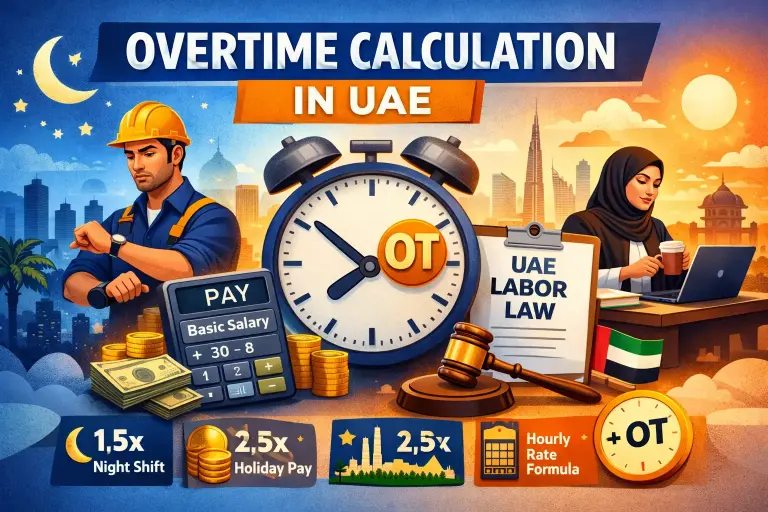
Overtime rules in the UAE are defined under Federal Decree-Law No. 33 of 2021, particularly within Articles 19, 20, and 21. These provisions form the legal foundation for how overtime is calculated, paid, and regulated across the private sector.
The law is implemented by the UAE Government, while oversight and enforcement are handled by MOHRE (Ministry of Human Resources and Emiratisation), ensuring that employers follow the approved standards for working hours and overtime compensation.
Article 19: Standard Working Hours
Article 19 establishes the baseline from which all overtime is measured. Under UAE labor law, the standard limit for working time is set at 8 hours per day or 48 hours per week. During the month of Ramadan, these working hours are officially reduced, with employees working 2 hours less per day. Employers can implement either a 5-day or 6-day work week, provided total weekly hours do not exceed 48. Any hours exceeding these prescribed limits are classified as overtime and require appropriate compensation under UAE labor law.
Article 20: Overtime Payment
Article 20 sets the legal rates and limits. Work beyond normal hours is paid at 125% of the normal wage (25% extra). Overtime falling between 9 PM and 4 AM is paid at 150% (50% extra). Overtime cannot exceed 2 hours per day under normal conditions, the only exception is when extra hours are absolutely necessary to prevent loss or damage, which corresponds to Force Majeure overtime. The yearly overtime limit is set at 144 hours, and any extension beyond this requires approval from MOHRE for specific projects or seasonal needs.
Article 21: Rest Days and Public Holidays
Article 21 covers compensation for working on rest days and public holidays. Working on the weekly rest day (typically Friday) entitles the employee to either a substitute day off or 150% pay. If an employee works on a public holiday, they receive their normal salary along with an extra 150%, making it 250% pay for that day, the maximum overtime rate in the UAE.
Key Legal Protections
Overtime requires mutual agreement; employers cannot routinely force overtime without employee consent
In genuine emergencies, refusal may have contractual consequences, but this exception is narrow and cannot be used to normalise excessive hours. Employees can file a formal complaint with MOHRE if overtime is unpaid or legal caps are violated.
For domestic workers, you can also calculate end-of-service benefits using our Domestic Worker Gratuity Calculator based on UAE Labour Law.
Who is Eligible for Overtime Pay?
Whether you are calculating overtime in Dubai, Abu Dhabi, or any other emirate, most workers in the private sector UAE are entitled to overtime compensation under Federal Decree-Law No. 33 of 2021. This includes:
For employees in special jurisdictions:
Both frameworks broadly protect overtime rights, but always verify the specific rules that apply to your employment zone.
Who is NOT Entitled to Overtime?
The following categories are generally excluded from standard overtime entitlement under UAE labor law:
- Senior executives and high-level managers with decision-making authority
- Government employees UAE, covered under separate civil service regulations, not the private sector labor law
- Workers governed under the domestic workers law UAE
- Employees whose nature of work makes fixed-hour tracking impractical
If you are unsure whether your role qualifies, review your employment contract or contact MOHRE for clarification.
Step-by-Step Overtime Calculation in UAE with Examples
If you want to know how to compute overtime in UAE, follow this proven process used in payroll calculation UAE across thousands of UAE businesses:
This method works equally well for manual calculations and for setting up overtime calculation in UAE in Excel using formula-based spreadsheets.
Critical Note: Always use basic salary, not your total package. The distinction between basic salary vs total salary is one of the most common sources of wrong overtime pay UAE. Allowances such as housing, transport, or food are excluded from the hourly rate calculation unless your employment contract explicitly states otherwise.
Let us walk through five practical overtime calculation in UAE examples to cover every common scenario.
Example 1: Regular Overtime
Example 2: Friday Work
Example 3: Public Holiday Work
Example 4: Combined Overtime (Night + Extra Hours)
This combined overtime pay example shows why the time of work, not just the hours, is essential for accurate payroll calculations UAE.
Example 5: Ramadan Overtime
Ramadan working hours lower the daily threshold, which means the overtime clock starts earlier in the day. Employers must account for this in their workforce management and payroll system UAE settings.
Overtime Calculation in UAE in Excel
For HR professionals managing large teams, overtime calculation in UAE in Excel is a practical solution. The formula structure directly mirrors the manual calculation:
=(B2/30/8)*C2*D2
Where:
- B2 = Basic Salary (AED)
- C2 = Number of Overtime Hours
- D2 = Overtime Multiplier (1.25, 1.50, or 2.50)
A well-structured spreadsheet with columns for basic salary, hourly rate, overtime type, hours, and total compensation creates an efficient in-house UAE overtime calculator system.
For other UAE labour law calculations, you can also use our UAE Gratuity Calculator to estimate end-of-service benefits quickly.
Why Your Overtime Pay May Be Wrong
Many employees in UAE complain:
Common Issues:
Common Calculation Mistakes to Avoid
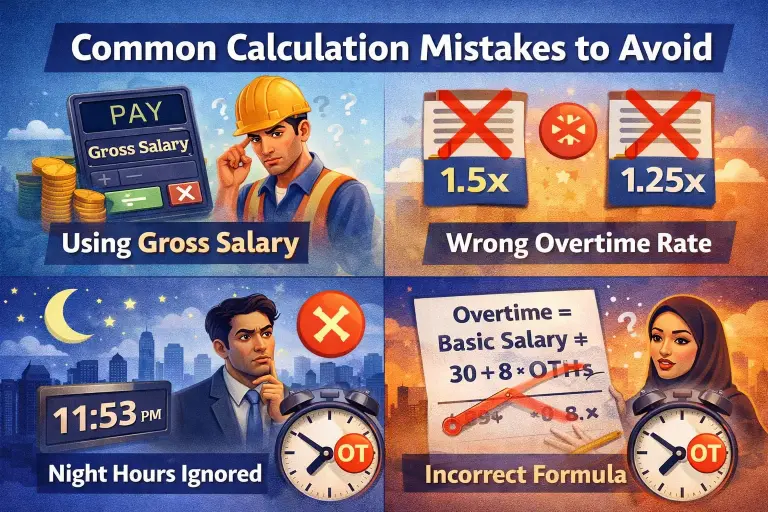
These overtime calculation in UAE mistakes appear repeatedly across UAE businesses, in both small firms and large HR departments.
Common Employee Complaints
These are trending questions online:
Solution:
Final Thoughts
Understanding overtime calculation in UAE is essential for fair work compensation and avoiding salary disputes. It strengthens HR policies UAE, supports efficient workforce management, and ensures every employee is paid correctly for every hour worked.
The rules are clear. Federal Decree-Law No. 33 of 2021 protects workers. MOHRE enforces employer obligations UAE. And the formula: Basic Salary ÷ 30 ÷ 8, gives everyone a transparent, verifiable starting point.
Whether you are processing payroll manually, building a spreadsheet, or checking your own salary breakdown UAE, use this guide as your reference. And for the fastest, most accurate result, use the Overtime Calculator UAE tool or download the overtime calculation in UAE Excel spreadsheet, no formulas, no guesswork, just the correct number every time.